Offering the occasional “Huh. I never thought of it like that before.”
Subscribe for short reflections on life, death and what actually matters in between.
One short note every week or two. No pressure. No noise. Unsubscribe anytime.
Latest Thoughts
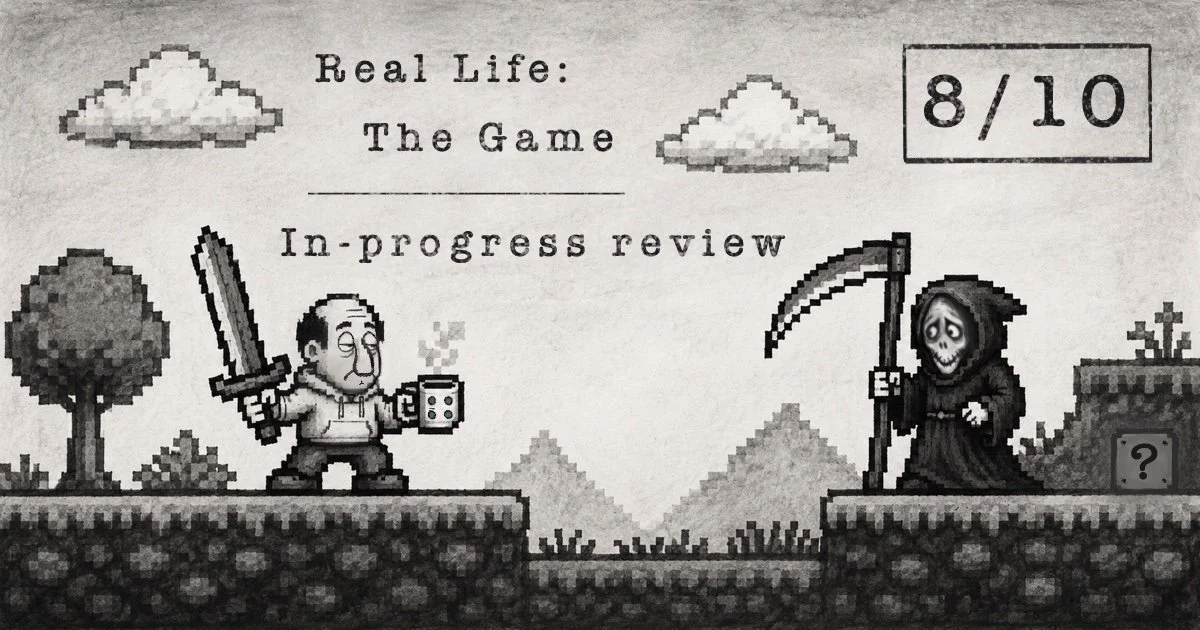
If life were a video game, here's my in-progress review
Real life is an open world, choice-driven MMORPG roguelite with strong story elements, a diverse range of interesting characters, challenging boss fights and a profound endgame that will leave you both wanting - and never wanting - to play it all over again.
“Rumor has it that the entire game was built from the ground up by a single developer, though that hasn’t been confirmed.”
Overview
Real life is an open world, choice-driven MMORPG roguelite with strong story elements, a diverse range of interesting characters, challenging boss fights and a profound endgame that will leave you both wanting - and never wanting - to play it all over again.
There are a few considerations that may deter some gamers from wanting to try it, but those who can stomach the grind, the challenging quests and the (sometimes) toxic lobbies are in for an unforgettable gaming experience with an unprecedented level of depth in both story and presentation.
Where the game really shines (the details)
Presentation and performance
Rumor has it that the entire game was built from the ground up by a single developer, though that hasn’t been confirmed. We haven’t had much of a behind-the-scenes look.
Either way, the developer(s) are using a proprietary engine here and what they’ve accomplished is nothing short of spectacular. From the graphics and level design to the lighting, dynamic weather, day/night cycles, changing seasons, memorable characters with their own backstories, and interesting POIs - there’s no other game out there with this level of detail. And it’s here, in the little things, where the player experience shines the most.
The sound design also boasts the same level of intricacy. Even without headphones, the sounds are layered in a way that make each element come across as distinct, while blending together naturally into a cohesive soundscape (albeit a sometimes loud one). The customizable soundtrack is also a nice touch, allowing you to choose from an endless library of music to accompany your adventures at virtually any time. During my playthrough, I’ve had a few moments where just the right song played at just the right time, and these moments were genuinely enhanced because of it.
And it all runs smoothly, for the most part. With over 354,780 hours played thus far on a serviceable rig, I’ve seen a handful of minor glitches and bugs, but none that disrupt the gameplay in any meaningful way. Frames are smooth and there’s virtually no pop-in even when moving through some of the map’s densest areas.
However, they did release a massive update in 2012, discontinuing physical copies and forcing players online even when in single-player mode. This completely broke the game for some, while enabling a whole new wave of problems unique to the now completely-online environment (unofficial mods, cheating, hackers, toxic lobbies, unstable connections, etc). They’ve since won back the community with several free DLC releases, but us old heads can’t help but feel like it’s just not quite the same.
Gameplay
Once your player is created and you go through the (rather long) tutorial, the map opens up and the real game loop begins. Overall, you’re in for a nice balance between platforming, exploration, choice dialogue, side quests, some combat and survival horror, with dramatic cut scenes sprinkled in across the bigger story moments.
Customization options are limitless and the RPG elements offer a dynamic but amazingly consistent skill tree structure. It can be a little confusing at first in terms of where to invest the XP you earn, but the more you play the more you start to understand which skills to upgrade based on how you want to approach the game.
The role-playing itself is deeply layered, allowing you to take on almost any role within the living and breathing world. Just be careful, as the choices you make, including the skills you choose to level up, come with lengthy grind sessions and meaningful consequences through the game’s punishing, micro-managerial reputation system. Every choice matters, and the fact that Permadeath is the only game mode offered might make the game overwhelming for many, even with the thorough tutorial.
While the nearly-infinite, procedurally-generated map operates as an open world, there are tons of diverse and highly-detailed levels and dungeons to explore therein. By land, air or sea, you are free to explore pretty much anywhere given you’ve leveled up the right skills, have the right access and have the appropriate gear equipped.
There are many POIs on the map that are some of the most beautiful you’ll ever see. It’s worth exploring as much of it as you can. There’s almost always good loot, a rewarding story moment and/or at the very least, the chance to soak in something new.
Story and characters
With such depth in the dialogue trees and choice-driven outcomes, it’s difficult to dive into a story that 1) will be different for everyone and 2) is still unfolding for me. Plus, I don’t want to spoil anything. I can say that it gets better as it goes on and that it’s worth sticking around to see how it unfolds for your character.
The NPCs you’ll run into along the way are diverse and interesting, each with their own backstories and routines that play out in real-time just as you play. Interactions can be approached in a number of ways, and each choice you make, each line of dialogue matters in how the overall story plays out.
Some interactions will unlock quests for you to take on, some may have romance storylines, some chance encounters can end up being the most memorable, some you may want to stay away from altogether (more on that later). All in all, for the most part, they each offer something unique and net positive for the overall experience.
Where the game kinda sucks (the games within the game)
Given the dynamism of the gameplay, each player is going to have their own take on this, but there are a few clear areas that may detract some players from wanting to try it.
The commitment
This isn’t some 20-hour single-player adventure. Getting the most out of the game requires a serious time and effort commitment (almost all of it). Even with how rewarding the game can be, casual gamers may be hesitant to jump in. But trust, once the hooks are in, you’ll be grinding non-stop and loving every level-up along the way.
Side quests and tasking
The reward system isn’t as instantaneous as we’ve come to expect from other open-world adventures. Here the main story quests are broken up into several side quests, which are broken up into several tasks, which often leaves the player confused about what the main objectives even are in the first place.
Players expecting to find a legendary Greatsword by chance in an early-stage dungeon should recalibrate expectations. Sure, the Greatsword can be obtained, but only through completing a long string of seemingly disparate and often arduous tasks. For some, the juice may not be worth the squeeze, and thus they’ll end up missing out on the endgame where the real rewards lie.
Menus and inventory management
Menus inside menus inside menus. Everything’s intuitive for the most part, but between the skill tree, gear upgrades/customization, base-building, social settings, the map, quest tracking and everything else - simply put: it’s a lot to manage, and it’s often difficult to find what you’re looking for when you need it.
Pay to play
The game is technically free to play, but you’ll be bombarded with constant microtransaction pop-ups and intrusive ads around nearly every corner. The only way to remove them is with a paid subscription.
And many of those microtransactions do provide a real advantage over other players. It often seems like the best-equipped players are simply the ones whose parents have the most coins to spend.
It’s nice that the game is constantly adding new content, and you can earn currency through quests and XP. Still, it’s hard not to roll your eyes when you run into an obnoxious player sporting high-tier loot they clearly didn’t earn.
Toxic player community
There are countless ways to interact with the community, including proximity chat. That can be a good thing, but it can also come with serious social baggage.
The system they use to report and ban players is inconsistent at best, so you’re left with lots of lurking cheaters (aim assist, wall-hacking, you name it), toxic players looking for clips/attention and players with nothing better to do than to troll other players.
And the game’s official Discord server is even more monstrous. Don’t even bother trying to find squad mates or walkthrough guides here. I can’t tell what’s worse, the content or the moderation of the content.
This isn’t necessarily the game’s fault, but for a game based on choices and consequences, this is a real deterrent for players who are looking for a more chill experience.
Now, you can choose to appear offline and virtually play the entire game solo, but that comes with its own drawbacks and you won’t make much progress through the story playing this way.
In-progress verdict
All of the aforementioned positives that this game brings to the table combine to facilitate the most consistently immersive and memorable gaming experience that’s ever been created. That’s not an overstatement. There are story moments throughout that will make you cry, scream, belly laugh, jump for joy and everything in between.
The developer(s) clearly put a lot of time and effort into making a living, breathing world that is as deep and detailed as it is wide and sprawling. For better or worse, you will be fully immersed in even the smallest of tasks to the point of it almost being too overwhelming.
You could argue that it’s not for everyone, that the player community is toxic and that the investment isn’t worth the payoff. But in my opinion, if it’s between this and GTA VI, you’ll get much more for your $80 playing this instead.
Admittedly, I’ll be playing both.
8/10.
I’ll give you a final verdict one I finish the main story. Well, a little before.
Subscribe for the occasional “Huh. I never thought of it like that before.”
One short note every week or two. No pressure. No noise. Unsubscribe anytime.

Stop Pursuing Happiness
The pursuit of happiness is a stupid, cheap trick.

Not too long ago, after a couple beers at the bar with a fellow patron, I brought up this familiar phrase, "The pursuit of happiness". Almost immediately, the gentleman I was sharing this conversation with myth-busted the happiness pursuit idea, and told me something that has stuck with me ever since:
"Sadness is just as important as happiness, and perhaps even more important. To me, life isn't about the pursuit of happiness. It's about the pursuit of experience."
He's right. I think the pursuit of happiness is a cheap trick. What about sadness, and all other emotions in between? Not to say that you should pursue sadness, but to choose only happiness - out the entire spectrum of emotion that we humans can experience - as the end-all-be-all in terms of life fulfillment, is stupid. I mean, how would you even know what happiness is, without taking the time to know sadness?
We're human. The fact that we can feel anything at all is a gift. Even if a feeling seems negative at the time, don't ignore it just because it isn't the feeling that you're after. Explore it. Appreciate it. Learn from it.
So, since I don't have a couple beers in me at this time, I'd like to improvise a bit on the thought that my fellow patron originally shared:
Pursue experiences that make you feel something, embrace and explore that something (even if it isn't happiness), and adjust your pursuits accordingly.
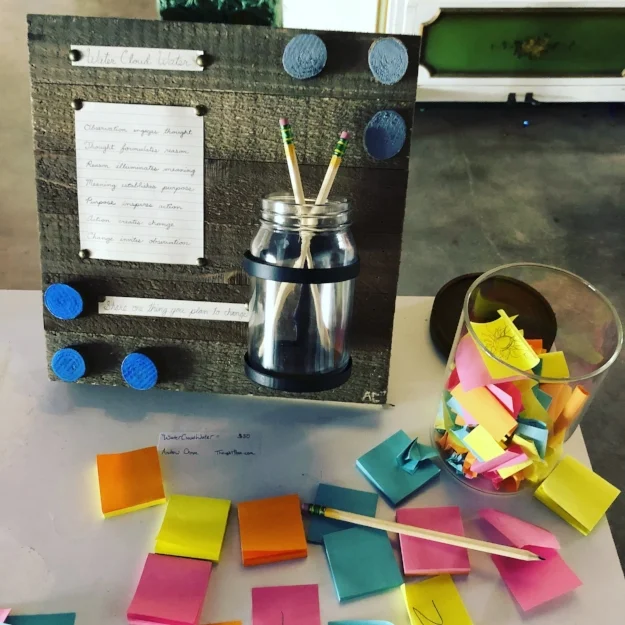
Here's What 43 People Want to Change about Life
I asked people to share one thing they planned to change. Here are the results.

"WaterCloudWater"
"Share One Thing You Plan to Change"
I have this recurring dream about us all working together toward something big. It's always the same.
I picture two people sitting across from one another at a kitchen table. They're having an open, honest conversation. The ratio between speaking and listening remains mutually equal throughout the exchange. They eventually form a common understanding. They smirk, clink their coffee mugs together, and become friends.
The dream always ends there. It's fucking sweet.
Anyway, I like poetry, so I wrote one about what that conversation could be, if we all could somehow have it together:
WaterCloudWater 1105172100
Observation engages thought
Thought formulates reason
Reason illuminates meaning
Meaning establishes purpose
Purpose inspires action
Action creates change
Change invites observation
I thought the poem came out ok, so I decided to show it at a local art show. It was an interactive piece so, along with the poem itself, I made a request to the audience:
Share one thing you plan to change.
Here are the responses I got from that request:
- Save all the damn dogs
- The way people with mental illnesses are perceived & treated
- My gender
- Level of openness to new energy
- My life
- Societal expectations
- My passion
- This
- My mental health. I have manic depression.
- FTW DON'T ASK ME 4 SHYT!
- Lives
- Bold action only
- Deep gratitude practice for all beings every day xoxo
- Sum bitch
- Job
- 💘
- My attitude about work
- Perspective
- Tha system
- Fake democracy
- I ❤️ Dick
- Tell me how you feel. I won't be mad.
- Sarah's sassiness
- Perception is everything
- Work ethic
- 💘 (different one)
- To thine own self be true
- Don't wanna change a thing, really... right now.
- Our comfort zone! Push the limits
- My self care
- The way that people interact with art!
- My inability to be vulnerable
- I want to make handmade, quality goods cool again
- Eat better
- Love myself more
- My underwear
- Habit
- Lose more control
- I am changing the way I view myself
- My mind
- Focus on myself and not compare myself to others
- Job
- Go Astros! 11-1-17
So regarding this conversation - the one at the kitchen table that I dream about - it seems to still remain internal for most.

Biocentrism Says Existence Is a Matter of Perception
If you are not there to observe it, does it exist?

“Without consciousness, space and time are nothing.” - Robert Lanza
As maniac as this idea may seem, it stands as a relatively popular theory known as biocentrism, or the theory of everything. It’s the idea that consciousness is responsible for the existence of the universe, not the other way around as physics would have you believe.
As all that we know from physics continues to yield more questions than answers, medical doctor and scientist, Robert Lanza, has presented this new way to approach the “why?” question. His theory of everything places biology first, suggesting that the “web would not exist without the spider.” A shared consciousness, which kindles our collective web of all things known, is responsible and necessary for the existence of the universe and, without this shared consciousness, there would simply be nothing.
From a different angle, this notion could be explained by suggesting that things don’t exist unless you are there to observe them. This has been countlessly demonstrated by the famous double-slit experiment, in which entangled particles only present themselves as identifiable when they are observed. When they are not observed, they do not exhibit any unique properties within any specific orientation of space and time, but rather present themselves as a wave with infinite possibility across all of space and time.
Through physics, we’ve made significant progress in understanding the nature of our universe. Matter is studied as we track its motion and behaviors, and various physical theories are put to the test against the laws we’ve mostly come to accept. And while this scientific method can allot a certain level of confidence to its known facts about the nature of our universe, it must insist that no scientific fact be considered an absolute truth.
Even science admits that the very nature of truth is a matter of perception, and thus can never be absolute.
This fact - that there are no facts - also presents a problem for the theory of biocentrism, and it all comes down to the “truth” about space and time. Biocentrism regards both space and time as mental tools that we use collectively to form a frame of reference for our existence, rather than regarding them as physical objects that can be measured. If you can’t measure space or time, then you can’t prove that they exist, or that anything exists within their respective boundaries, including the theory of biocentrism.
It’s funny and ironic to think that nothing is true yet, as you observe it to be, it is.

"Look Again at That Dot."
Let's take a closer look at this photograph of Earth, from Saturn's perspective.

Earth from Saturn, as captured by NASA's Cassini spacecraft in April of 2017
"Look again at that dot. That's here. That's home. That's us." - Carl Sagan, Pale Blue Dot: A Vision of the Human Future in Space
Take a moment to observe one of the many now-famous images captured by NASA's Cassini spacecraft, in which Earth was wondrously captured as the only source of light between the acting frame of Saturn's rings.
While this image may prompt thoughts of our sheer insignificance in the grand scheme of things, challenge yourself to examine this photograph from a different angle.
Consider just some of the many, many factors needed to sustain life on a planet, amidst the desolate and violent conditions of space: being the right distance from the sun to allow for water to melt, being in the “habitable zone” of the galaxy to avoid deadly radiation, having a near-perfect circular orbit to maintain consistent warmth and light, having a moon that creates tides, and so on. And, by the way, it doesn’t hurt to have “gas giant” neighbors, like Saturn, to attract asteroids and comets, often preventing them from reaching us.
As it seems, we just happened to be in the right place at the right time. Whether by luck, by fate, or perhaps by something we do not yet understand, behold life.
From the first microorganisms to the ~8 million species that now reside here, life on Earth has evolved over the years. Us humans, the luckiest of the bunch, have even grown to possess a heightened state of consciousness, for better or worse. That is to say we have the ability to do extraordinary things like imagine, perceive, and love.
Let this image of Earth pose a thought, not on insignificance, but on what can become of being in the right place at the right time. Whether by luck, by fate, or perhaps by something we do not yet understand, behold.

Two Things...
Two quick things to always keep in mind.
"Don't be an asshole, and there's more than just yourself." - Shane
This isn't a blog post. That's literally it.
Follow Shane's advice, and you should be fine.